
Global Shutter Camera for ANPR: Challenges & Solutions
Automatic Number Plate Recognition (ANPR) systems demand precision, speed, and reliability. While standard IP cameras suffice for many surveillance tasks, high-speed ANPR applications require a different class of imaging technology: the global shutter camera.
Unlike rolling shutter sensors that scan the image line by line, global shutter cameras capture the entire frame in a single instant. This eliminates motion blur — critical when reading license plates on vehicles travelling at 120 km/h or more. But this advantage comes with a unique set of engineering challenges.
Why Global Shutter Matters for ANPR
When a vehicle crosses an ANPR capture zone at highway speed, even a few milliseconds of exposure time can produce significant motion blur on a rolling shutter sensor. The result: unreadable plates, failed recognition, and enforcement gaps.
Global shutter sensors expose every pixel simultaneously, freezing the scene at a precise moment. This makes them the preferred choice for:
- Highway speed enforcement (100+ km/h)
- Multi-lane tolling systems
- Intersection ANPR with cross-traffic
- Railway level crossing monitoring
Challenge 1: Radar-Camera Coordination
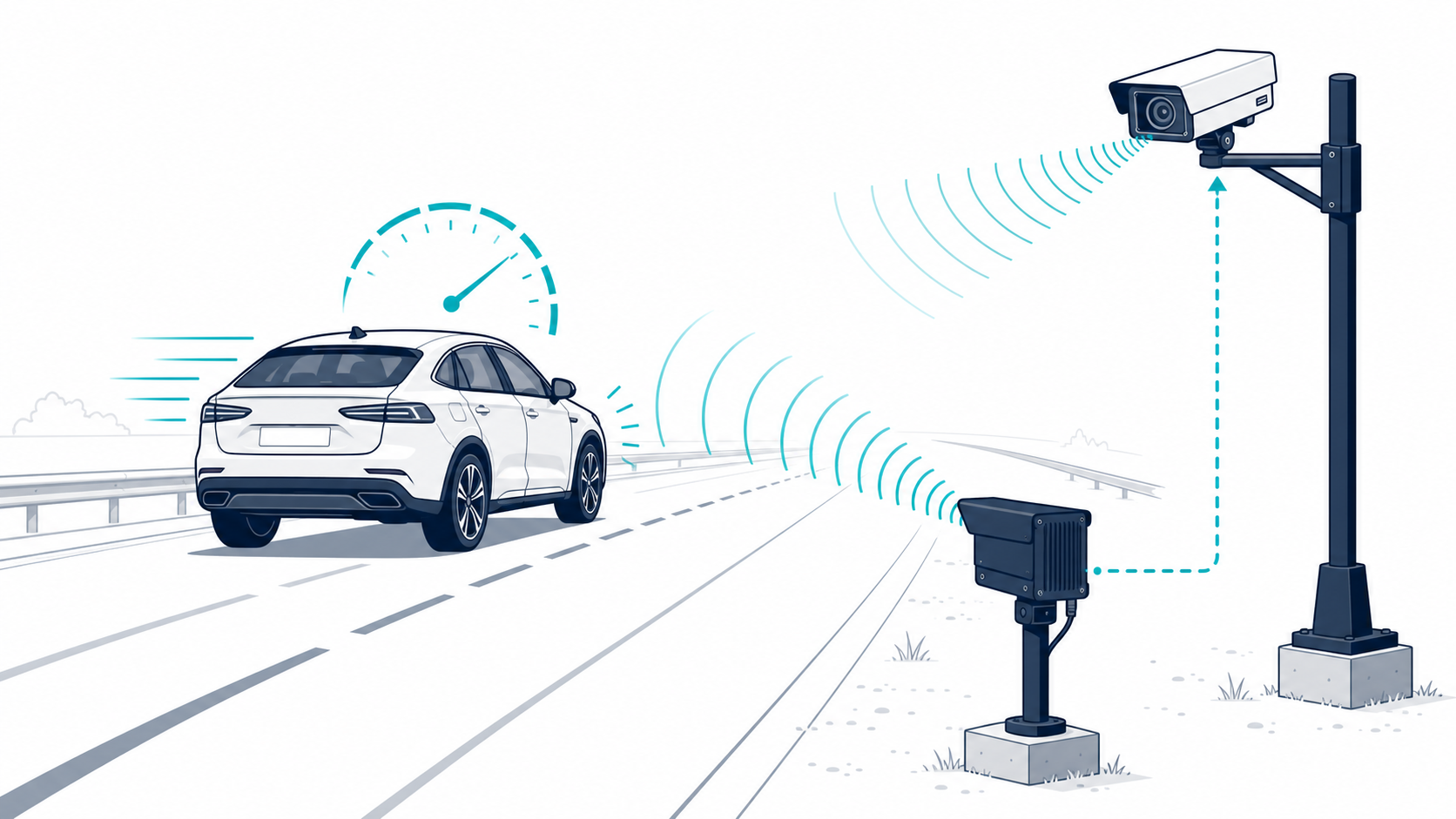
A global shutter camera cannot simply capture continuously — that would waste storage and processing resources. Instead, it relies on an external trigger, typically from a radar sensor.
The workflow:
- Radar detects an approaching vehicle and measures its speed
- Radar sends a trigger signal to the camera at the precise moment the vehicle enters the optimal capture zone
- Camera captures a single frame (or burst) at that instant
- ANPR software processes the plate image
This coordination must be tightly synchronised. A delay of even 50 milliseconds means the vehicle has moved approximately 1.7 metres at highway speed — potentially missing the plate entirely or capturing it at an unreadable angle.
Timing Considerations
- Trigger latency: The time between radar detection and camera capture must be minimal and predictable
- Camera readiness: The camera must be in a state to receive and act on the trigger instantly
- Multi-vehicle scenarios: When multiple vehicles approach simultaneously, the system must prioritise and sequence captures
Challenge 2: IR Illuminator Synchronisation
ANPR systems must work 24/7, including at night and in challenging lighting conditions. This requires infrared (IR) illuminators to light up license plates without blinding drivers.
The IR illuminator introduces additional coordination complexity:
- Power timing: The IR illuminator must be powered on before capture and can be turned off between captures to extend its lifespan
- Trigger coordination: Some systems send a separate trigger to the IR illuminator to synchronise with the camera capture
- Flicker rate matching: Captures may be timed to match the IR illuminator's flicker rate, ensuring consistent illumination across frames
- FOV alignment: The IR illuminator must be precisely positioned to cover the camera's field of view, ensuring plates are evenly illuminated
Night Capture Challenges
At night, the IR illuminator becomes the primary light source. If the synchronisation between camera and IR fails, the result can be:
- Overexposed plates (IR too bright or capture too long)
- Underexposed plates (IR too dim or misaligned)
- Inconsistent illumination across multiple lanes
Challenge 3: No Auto-Exposure
This is perhaps the most underappreciated challenge of global shutter cameras for ANPR.
Standard IP cameras offer auto-exposure — they continuously adjust shutter speed and gain based on the scene's brightness. Global shutter cameras used in ANPR typically do not have built-in auto-exposure.
Instead, the camera expects exposure settings to come from an external source:
Light-Dependent Resistor (LDR)
An LDR sensor mounted near the camera continuously measures ambient light intensity. The system uses this reading to calculate appropriate exposure settings:
- Daytime: Shorter exposure, lower gain
- Overcast: Moderate exposure, moderate gain
- Nighttime: Longer exposure, higher gain (compensated by IR)
- Transitions: Dawn, dusk, tunnel entry/exit — rapid light changes require fast adaptation
Image-Based Exposure Feedback
Some advanced systems use the captured image itself to readjust exposure:
- Capture a frame
- Analyse the plate region's brightness
- If too dark or too bright, adjust exposure for the next capture
- Repeat until optimal exposure is achieved
This feedback loop must converge quickly — there is no luxury of multiple attempts when a vehicle passes through the capture zone in a fraction of a second.
Environmental Factors
Exposure management must account for:
- Headlight glare from oncoming traffic
- Reflective road surfaces after rain
- Shadow patterns from overhead structures
- Sudden changes (clouds passing, streetlights turning on/off)
Global Shutter vs. Regular IP Cameras for ANPR
| Factor | Global Shutter | Regular IP Camera (Rolling Shutter) |
|---|---|---|
| Motion blur | Eliminated | Present at high speeds |
| Trigger control | External radar trigger | Continuous or motion-triggered |
| Auto-exposure | External (LDR/image-based) | Built-in |
| Night capability | Requires IR illuminator sync | Built-in IR or starlight sensor |
| Cost | Higher | Lower |
| Complexity | Multifold challenges | Simpler deployment |
| Best for | Highway, high-speed, precision | Urban, low-speed, general surveillance |
The challenges are multifold with global shutter cameras. From radar coordination and IR synchronisation to external exposure management, every component must work in concert. Regular IP cameras, while simpler, cannot deliver the precision required for high-speed ANPR applications.
Implementation Considerations
When deploying global shutter camera ANPR systems:
- Radar selection: Choose radar with low trigger latency and accurate speed measurement
- IR placement: Position illuminators to cover the full capture zone without hot spots
- Exposure strategy: Implement LDR-based or image-based exposure control with fast convergence
- System testing: Validate capture quality across speed ranges, lighting conditions, and weather
- Maintenance access: Ensure IR illuminators and LDR sensors are accessible for calibration
Conclusion
Global shutter cameras are essential for high-speed ANPR, but they bring engineering challenges that go far beyond standard camera deployment. Radar synchronisation, IR illuminator coordination, and external exposure management each require careful design and testing.
For organisations evaluating ANPR solutions, understanding these challenges is critical to selecting the right technology and deployment partner. The complexity is real — but so is the payoff in accuracy and reliability.
Interested in learning how Pixuate approaches these challenges? Contact us or request a demo to see our ANPR solutions in action.
About the author
Admin User
Pixuate — AI-powered video analytics for smarter, safer operations.
Related Articles


Comments (0)
Please login to leave a comment.