

4G / 5G Internet
Cellular broadband connectivity for remote and mobile Pixuate deployments
What is 4G/5G Internet?
4G (fourth generation) and 5G (fifth generation) are cellular mobile network standards that provide broadband internet access wirelessly over the mobile operator's infrastructure. Unlike wired fibre or DSL connections, 4G/5G uses radio towers to deliver connectivity anywhere within the operator's coverage area — including remote highways, construction sites, parking lots, and rural facilities where wired internet is unavailable or impractical to install.
- 4G LTE: Typical speeds of 10–100 Mbps download, 5–30 Mbps upload in good coverage conditions. Latency of 20–50 ms. Sufficient for 2–6 standard IP cameras in cloud mode.
- 5G: Typical speeds of 100 Mbps to 1+ Gbps, latency under 10 ms. Supports dense camera arrays and real-time edge processing with cloud sync.
The 4G/5G Modem and Router
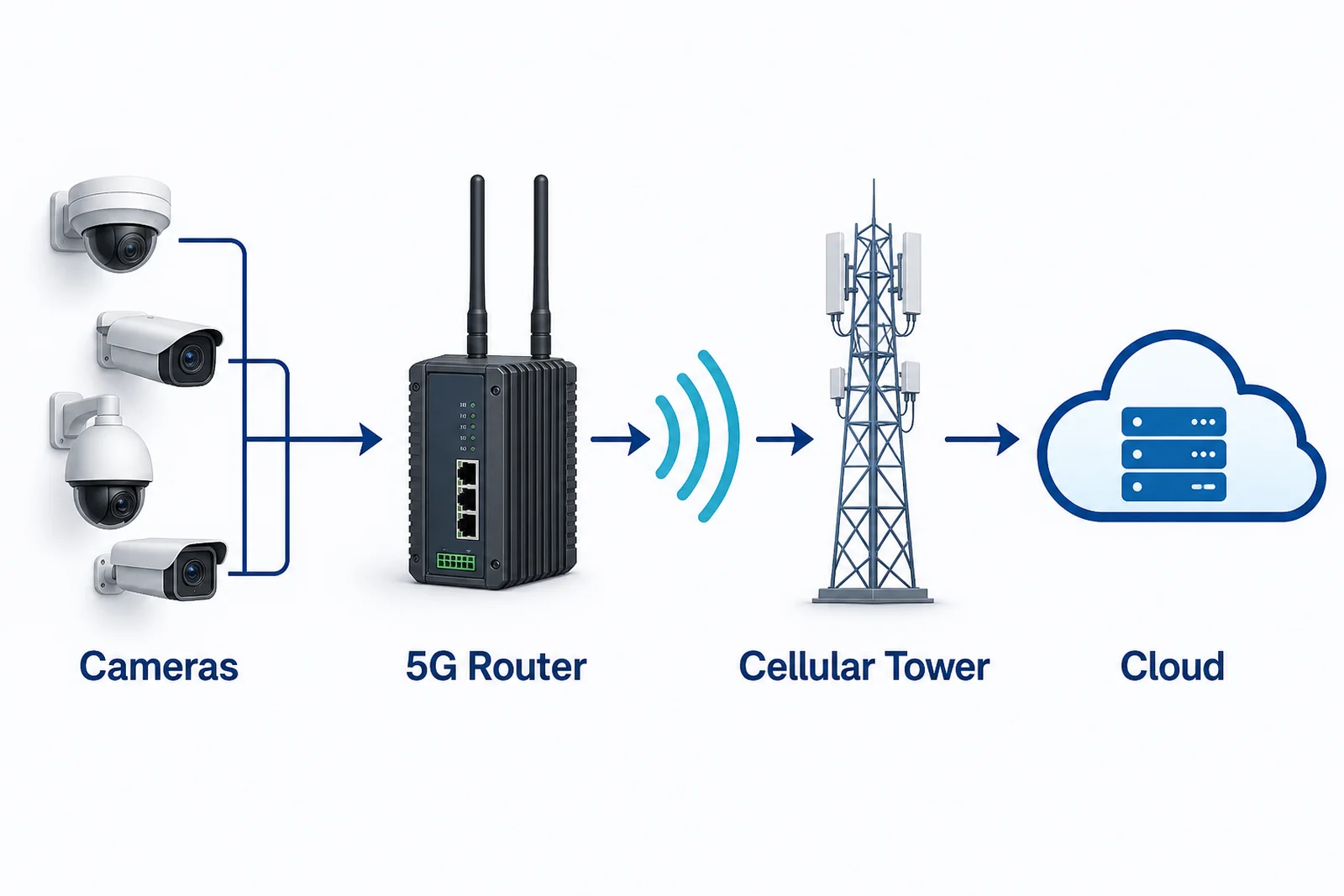
A cellular modem (also called a 4G/5G router or mobile broadband router) is the device that connects to the mobile network and provides a local ethernet or Wi-Fi connection for your cameras and server. It contains a SIM card from a mobile operator and converts the cellular signal into a standard IP network connection.
In a Pixuate deployment, the modem/router sits between the camera switch and the internet, providing the uplink for cloud-mode analytics or for remote access to an edge server. Key features to look for:
- Dual-SIM failover: Switches between two operator SIMs if one loses signal — critical for unattended remote sites.
- DIN rail or IP-rated enclosure: For outdoor cabinets and pole-mount installations.
- Static IP or VPN support: Required for fixed server addressing and secure remote access.
- LAN ports: At least one Gigabit ethernet port to connect to the PoE switch.
- Antenna connectors: External antenna support for poor-signal environments.
Bandwidth Planning for Cameras
The uplink bandwidth from the site to the cloud or remote server must be sufficient for all camera streams. Typical H.265 stream bitrates:
- 2 MP (1080p) — 1.5–3 Mbps per camera
- 4 MP — 3–5 Mbps per camera
- 8 MP (4K) — 5–10 Mbps per camera
For a 4-camera deployment with 2 MP H.265 cameras: 4 × 3 Mbps = 12 Mbps upload required. A standard 4G connection with 20 Mbps upload is sufficient. For 8–12 cameras, 5G or a dedicated 4G connection with a high-data plan is recommended.
Edge deployment (on-site analytics server, only alert data sent to cloud) dramatically reduces bandwidth requirements — instead of streaming raw video to the cloud, only metadata, thumbnails, and alerts are uploaded, reducing data usage by 90% or more.
Use Cases for 4G/5G in Pixuate Deployments
- Highway and roadside ANPR: Traffic monitoring locations far from any wired infrastructure. 4G modem in a roadside cabinet.
- Construction site monitoring: Temporary deployments where installing cable is impractical. Remove and redeploy as the site develops.
- Remote parking and open-air facilities: Large parking areas or outdoor event venues without existing fibre or copper runs.
- Temporary enforcement: Mobile ANPR or violation detection units deployed in vehicles or portable cabinets.
- Backup / failover: 4G modem as secondary internet connection when primary wired link fails.
Deploying at a Remote Site?
Pixuate can advise on connectivity architecture, modem selection, and edge vs cloud trade-offs for sites without wired internet.