
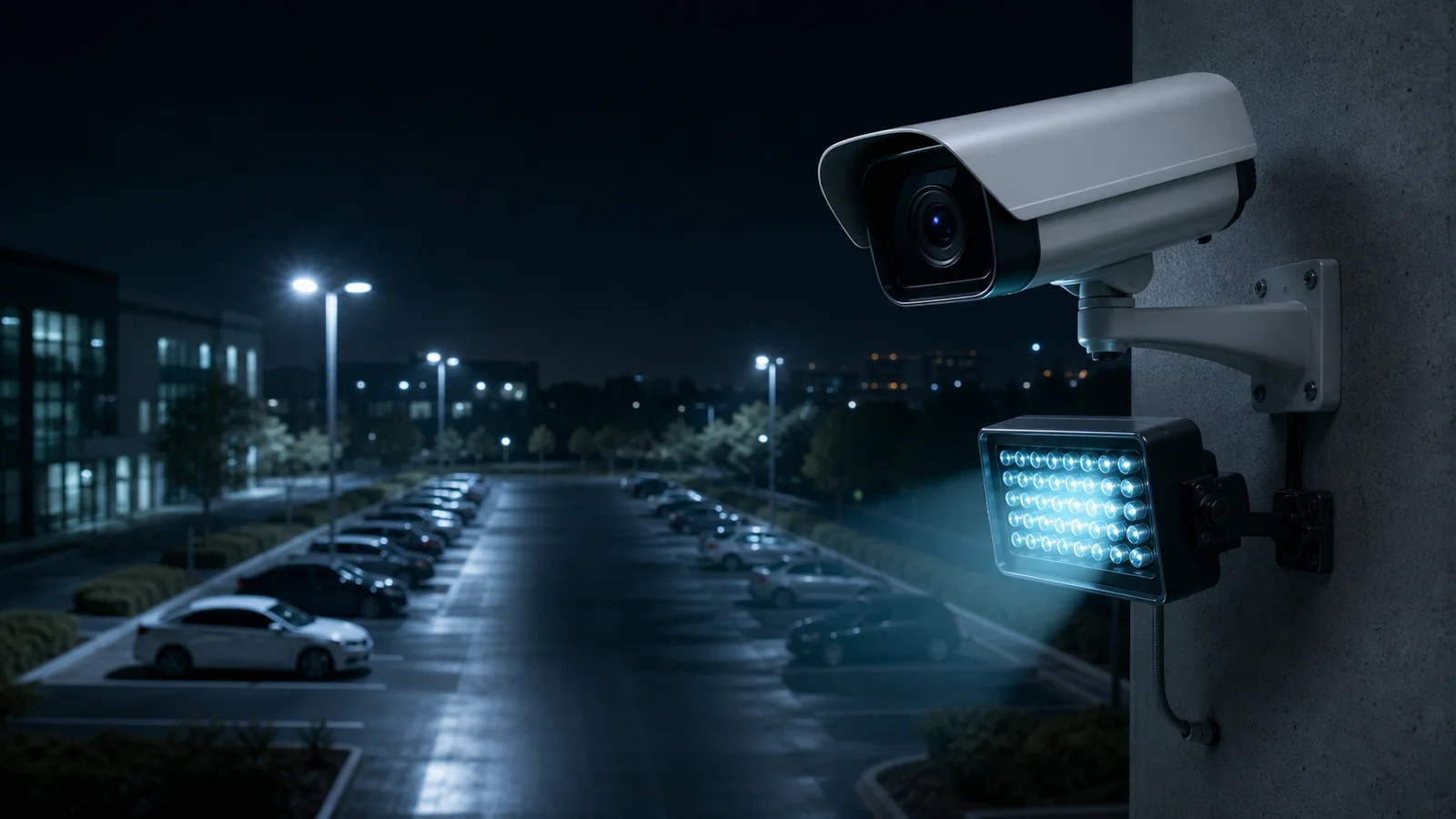
IR Illuminator
The external light source that makes nighttime ANPR and surveillance possible — and why wavelength choice matters
What is an IR Illuminator?
An IR illuminator is an external light source that emits infrared light to illuminate a scene for camera capture in low-light or zero-light conditions. Infrared light is outside the visible spectrum of the human eye but is detected by camera image sensors — so the scene appears fully lit to the camera while remaining completely dark (or nearly so) to human observers.
In surveillance and traffic enforcement deployments, IR illuminators solve a fundamental problem: cameras need light to produce a clear image, but visible floodlights disturb drivers, reveal the camera's presence, and are impractical at many roadside locations. IR illuminators provide the camera with the light it needs without any of these side-effects.
For ANPR (number plate reading), a well-matched IR illuminator is as important as the camera itself. A camera pointed at a dark road with no illuminator — or the wrong illuminator — will produce blurred, unusable plate images regardless of how capable the AI is.
Visible Light vs Infrared: How Camera Sensors See
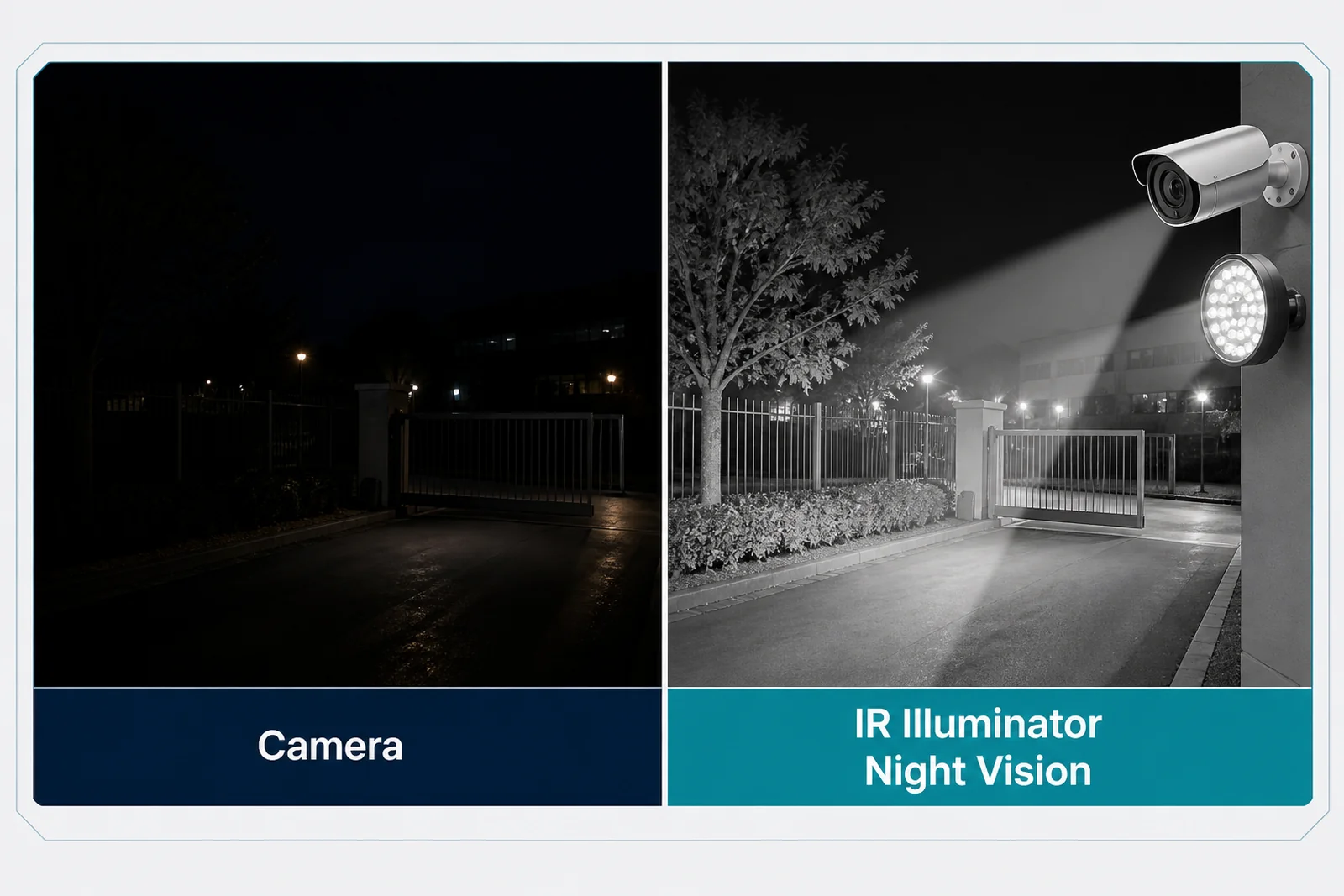
The human eye sees light in the visible spectrum — roughly 400 nm (violet) to 700 nm (deep red). Camera image sensors, particularly CMOS sensors, are sensitive across a much wider range: from around 300 nm (UV) to 1100 nm (near-infrared). This means cameras can "see" infrared light that humans cannot.
Most IP cameras include an IR cut filter — a mechanical filter that blocks infrared light during the day so that colours appear natural (without the filter, daylight images look washed out). At night, the camera automatically removes this filter to allow IR light in, switching to a monochrome (black-and-white) image that is sensitive to infrared. This is the "Day/Night" switching mode seen in all surveillance cameras.
This sensor characteristic is what makes IR illuminators effective: they emit light the sensor detects clearly, but which is invisible (or nearly invisible) to humans in the scene.
IR LED Wavelengths: 740 nm, 850 nm, and 940 nm
IR illuminators use LED arrays to emit infrared light. The wavelength of the LEDs determines how visible the illuminator glow is to humans, how efficiently the camera sensor detects the light, and the maximum effective range. Three wavelengths are used in surveillance and traffic applications:
740 nm — Near-Infrared (Visible Glow)
At 740 nm, the light is at the very edge of the visible spectrum. Most people will see a distinct red-purple glow from the illuminator LEDs when looking directly at them. Camera sensors detect 740 nm efficiently — sensitivity is high, meaning longer range is achievable with lower LED power.
- Pros: Longest effective range for a given power level; good camera sensor sensitivity.
- Cons: Visible glow reveals the illuminator position; not suitable for covert deployments.
- Best for: Perimeter security, access control, areas where illuminator visibility is not a concern.
850 nm — Standard Infrared (Faint Glow)
850 nm is the most widely used wavelength in surveillance. It is outside the range of normal human vision, but individuals with high visual sensitivity — or when looking directly at the LED array at close range — may detect a very faint dark red glow. Camera sensors are highly sensitive to 850 nm, making it the best balance of range, invisibility, and sensor efficiency.
- Pros: Excellent camera sensitivity; long range; effectively invisible in most conditions.
- Cons: Faint glow visible to some people at close range; not fully covert.
- Best for: General ANPR, perimeter monitoring, outdoor surveillance, most nighttime camera applications.
940 nm — Covert Infrared (Completely Invisible)
940 nm is well outside the range of human vision — the illuminator is completely invisible even when looked at directly. However, camera sensors are significantly less sensitive at 940 nm than at 850 nm. To achieve the same scene illumination, a 940 nm illuminator requires approximately 40–60% more LED power than an 850 nm unit. Effective range is shorter for the same power level.
- Pros: Fully covert — no glow visible to drivers or subjects; preferred for enforcement where flash must not startle drivers.
- Cons: Shorter range for equivalent power; more expensive for equivalent output.
- Best for: Traffic enforcement ANPR (speed cameras, red light cameras), covert perimeter surveillance, deployments where the illuminator must not be noticed.
Wavelength Comparison at a Glance
| Wavelength | Human Visibility | Camera Sensitivity | Effective Range* | Best Application |
|---|---|---|---|---|
| 740 nm | Visible red-purple glow | High | Longest | Perimeter, access control |
| 850 nm | Faint glow (close range) | High | Long | General ANPR, surveillance |
| 940 nm | Completely invisible | Moderate | Medium | Traffic enforcement, covert |
*Effective range assumes equivalent LED power output across units.
Illuminator Types
- Fixed-angle (spot) illuminator: Narrow beam, typically 10°–30°. Concentrates light on a specific zone — a lane, a gate, a doorway. High intensity at distance. Used for ANPR where the camera is aimed at a fixed lane.
- Wide-angle illuminator: Broad beam, 60°–120°. Illuminates a large area. Used for general scene illumination in car parks, perimeter zones, and retail forecourts.
- Adjustable-angle illuminator: Beam angle is adjustable at installation. Provides flexibility for non-standard coverage zones.
- Pulsed / strobe illuminator: Emits a high-intensity pulse synchronised with the camera shutter rather than continuous output. Produces a very bright brief flash that freezes motion — essential for high-speed ANPR where a continuous-output illuminator would cause motion blur. The short pulse duration allows very high peak power without overheating. Used in all speed enforcement and high-speed road ANPR deployments.
- White-light (visible) illuminator: Emits visible white light rather than IR. Used where colour image capture is required at night — vehicle colour for evidence, or where visible deterrence is desired. Not suitable for covert deployments.
IR Illuminators in Pixuate ANPR Deployments
Pixuate's ANPR products are calibrated for specific illuminator configurations. Key design decisions for nighttime ANPR:
- Wavelength: 940 nm covert for enforcement cameras where drivers must not be disturbed; 850 nm for standard monitoring where range is the priority.
- Pulsed vs continuous: Pulsed illuminator with shutter synchronisation for vehicles above 30 km/h. Continuous illuminator for low-speed zones (car parks, gates).
- Illuminator angle: Matched to the camera lens field of view. A 4 mm lens with a 90° FOV paired with a 10° spot illuminator will leave the edges of the scene in darkness — the illuminator beam must cover the camera's full frame.
- Range: Illuminator range must reach the furthest point in the camera's lane coverage. For a camera mounted at 5 m height aimed at 20 m down the road, the illuminator must reach at least 25 m effectively.
Pixuate provides illuminator specifications as part of each ANPR site design — contact the team with your lane geometry, vehicle speed, and mounting constraints.
Designing a Nighttime ANPR Deployment?
Pixuate can specify the right IR illuminator wavelength, type, and beam angle for your site layout and vehicle speed profile.