
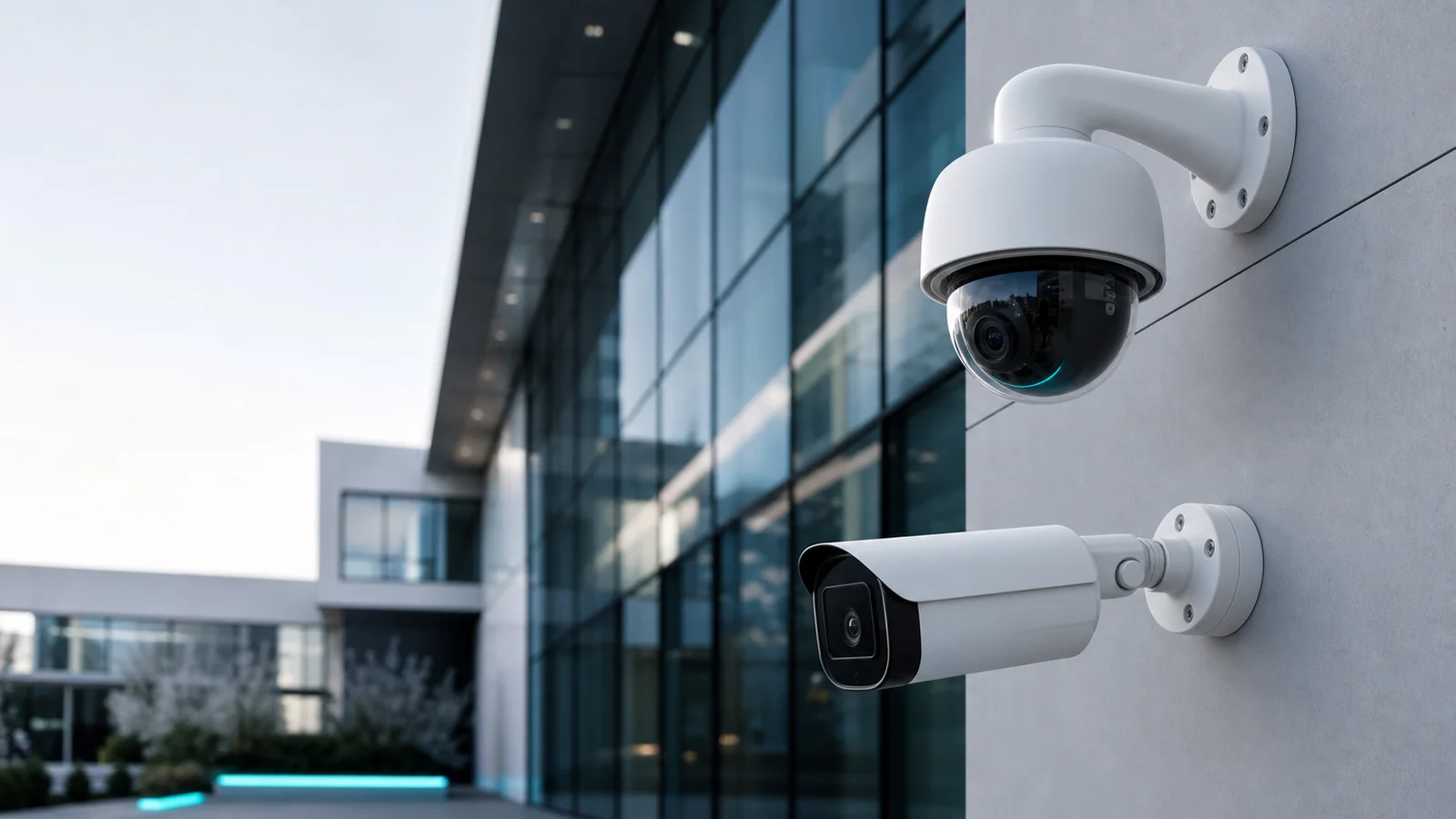
IP Camera
The primary capture device behind every Pixuate AI analytics deployment
What is an IP Camera?
An IP camera (Internet Protocol camera) is a digital video camera that transmits footage over an ethernet or Wi-Fi network rather than through a traditional analogue coaxial cable. Unlike CCTV cameras that require a dedicated DVR and analogue wiring, an IP camera encodes video on-device and streams it as data packets across your local network or the internet.
IP cameras are the standard input for all AI-based video analytics systems, including every Pixuate product. They come in several form factors and lens types — choosing the right combination for a location directly affects analytics accuracy.
How an IP Camera Works
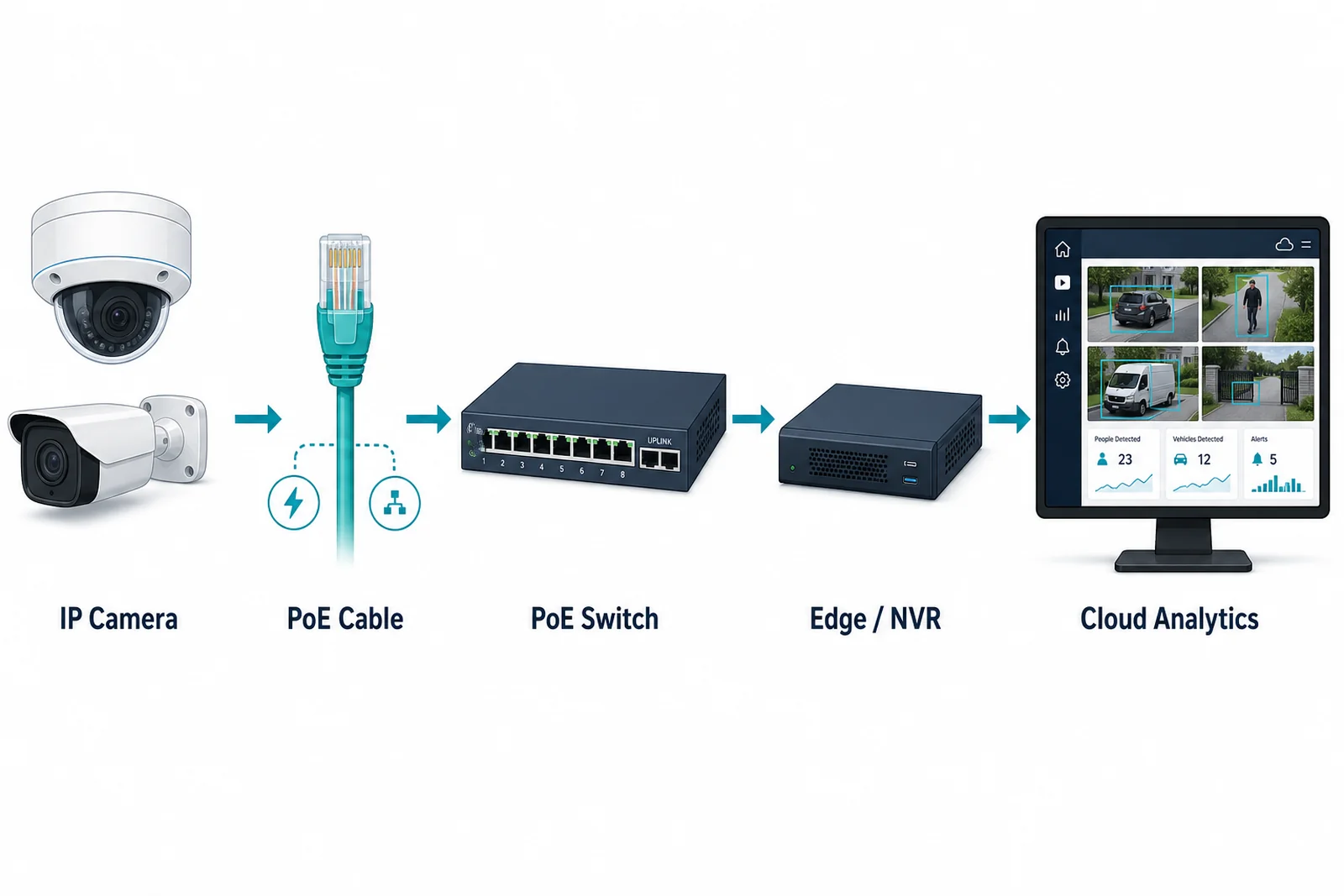
The camera captures a scene using a CMOS image sensor, compresses the video using a codec (H.264 or H.265), and streams it over the network using RTSP/ONVIF. A connected NVR, edge server, or cloud platform receives and processes the stream.
- Power: Most IP cameras are powered via PoE (Power over Ethernet) — the same CAT6 cable carries both data and power. No separate power outlet is needed at the camera.
- Connection: Cameras connect to a PoE network switch, which links to the analytics server or cloud uplink.
- Control: Cameras are configured remotely via web interface or ONVIF — adjusting resolution, frame rate, IR, and motion zones without physical access.
Lens Types: Fixed Focal vs Varifocal
The lens determines how much of the scene is visible and how much detail is captured at a given distance. IP cameras come with two lens types:
Fixed Focal Lens
A fixed focal length lens has a set angle of view that cannot be changed after installation. Common focal lengths:
- 2.8 mm — very wide angle (~100°–110° horizontal). Covers large areas at close range. Used for room-wide coverage, entrance halls, retail aisles.
- 4 mm — moderate wide angle (~80°–90°). The most common general-purpose focal length for indoor and outdoor surveillance.
- 6 mm — medium narrow (~50°–60°). Good for corridor monitoring and medium-distance outdoor coverage.
- 8 mm / 12 mm — narrow angle (~30°–40°). Used for long-distance outdoor monitoring, perimeter coverage, and vehicle detection at distance.
Fixed focal cameras are lower cost, more reliable (no moving parts in the lens), and sufficient for most installations where the mounting position and coverage zone are fixed during design.
Varifocal Lens
A varifocal lens has an adjustable focal length, allowing the installer to set the field of view after mounting. Motorised varifocal lenses can be adjusted remotely via the camera's web interface without physically accessing the camera — useful for hard-to-reach mounting positions.
- Typical varifocal range: 2.7–13.5 mm or 4–16 mm — covering wide to narrow in a single camera.
- Allows fine-tuning on-site to match the exact coverage zone needed.
- Preferred where coverage requirements may change, or where precise framing of a lane, gate, or zone is needed.
Dome Cameras
Dome cameras are housed in a compact circular enclosure designed for ceiling or wall flush-mount. The dome-shaped cover conceals the lens direction, making it difficult for subjects to determine where the camera is pointing — a deterrence advantage in retail and public spaces.
Fixed Dome
A fixed focal or fixed varifocal lens mounted in a dome housing. The lens angle is set at installation. Dome housing provides vandal resistance (IK10 rating) and a low-profile appearance. Common in indoor environments: retail stores, offices, corridors, lobbies.
Varifocal Dome
A motorised varifocal lens in a dome housing. Combines the discreet housing of a dome with flexible field-of-view adjustment. Used in larger indoor spaces, shopping malls, and covered parking areas where coverage zones are harder to predict before installation.
Outdoor Dome (IP66+)
Dome cameras rated IP66 or higher are designed for ceiling-mount in outdoor covered areas — petrol station canopies, building overhangs, covered walkways. The dome housing protects against rain and dust while maintaining a low profile.
When to use dome cameras with Pixuate
- People counting, queue detection, retail analytics — wide-angle ceiling mount
- Worker safety monitoring in indoor factory environments
- Indoor perimeter and access point monitoring
- Footfall counting at entrances and corridors
Bullet Cameras
Bullet cameras have a cylindrical or rectangular housing designed for wall or pole mounting. The housing is elongated to accommodate a longer lens and built-in IR illuminators, making bullet cameras the standard choice for outdoor, long-range, and exposed environments.
Fixed Focal Bullet
A fixed lens in a bullet housing. Straightforward, low-cost, and reliable. The most common choice for outdoor perimeter monitoring where the mounting point and coverage zone are well-defined during design. Typical lens: 4 mm, 6 mm, or 8 mm depending on distance.
Varifocal Bullet
Motorised varifocal lens in a bullet housing. Preferred for outdoor deployments where precise framing of a gate, road segment, or perimeter line must be adjusted on-site. Varifocal bullets are common in traffic monitoring, ANPR lane setups, and large outdoor perimeter systems.
Characteristics of bullet cameras
- Longer IR range: The elongated housing fits larger IR LED arrays — IR ranges of 50 m to 100 m+ are common, versus 20–40 m for compact dome cameras.
- Visible deterrent: The camera form is clearly identifiable, which has a deterrence effect.
- Directional: Housing is aimed at the coverage zone and locked. Not suitable for wide-area flexible coverage (use PTZ for that).
- Weather protection: Built-in sun visor (hood) on most bullet cameras reduces glare and rain interference with the lens.
When to use bullet cameras with Pixuate
- ANPR and vehicle detection lanes — varifocal bullet with global shutter
- Outdoor perimeter monitoring — fixed or varifocal bullet with long-range IR
- Highway and road traffic monitoring
- Remote asset and construction site monitoring
Other Form Factors
- PTZ Camera: Pan-tilt-zoom with motorised movement. Covers very large areas and can track moving subjects. See the dedicated PTZ Camera guide for full detail.
- Fisheye Camera: 180°–360° panoramic coverage from a single ceiling-mounted unit. Requires dewarping software. Used for full-room coverage in retail, warehouses, and open plan offices.
- Box / Housing Camera: Separate camera body and interchangeable lens. Used for specialised applications like ANPR lanes where a specific focal length and global shutter sensor are required. No built-in IR — external illuminator used.
Key Specifications to Know
- Resolution: 2 MP (1080p), 4 MP, 5 MP, 8 MP (4K). Higher resolution = more detail and better analytics accuracy at distance.
- Frame rate: Typically 15–30 fps. For ANPR and fast vehicles, 25 fps or higher.
- Shutter type: Rolling shutter (standard) or global shutter (required for fast-moving vehicles — see the Global Shutter guide).
- IR night vision: Built-in IR LEDs for low-light. Range varies from 20 m (compact dome) to 100 m+ (long-range bullet).
- IP rating: IP66 or IP67 for outdoor installations.
- IK rating: IK10 for vandal-resistant dome housings.
- Compression: H.265 halves bandwidth vs H.264 — preferred for multi-camera deployments.
- ONVIF compliance: Required for all Pixuate integrations. See the ONVIF guide.
Choosing the Right Camera for Your Pixuate Deployment
| Use Case | Recommended Form Factor | Lens Type | Notes |
|---|---|---|---|
| ANPR / traffic lane | Bullet or Box | Varifocal | Global shutter required |
| Outdoor perimeter | Bullet | Fixed or Varifocal | Long IR, IP66+ |
| People counting / retail | Dome (ceiling) | Fixed wide (2.8–4 mm) | Top-down view preferred |
| Worker safety (indoor) | Dome or Fisheye | Wide angle | Coverage of work zones |
| Wide-area outdoor | PTZ | Optical zoom | See PTZ guide |
| Vehicle incident / highway | Bullet (varifocal) | Varifocal + global shutter | High frame rate |
Need Help Selecting the Right Camera?
Pixuate's team can recommend the right camera form factor, lens, and mounting position for your specific analytics deployment.