
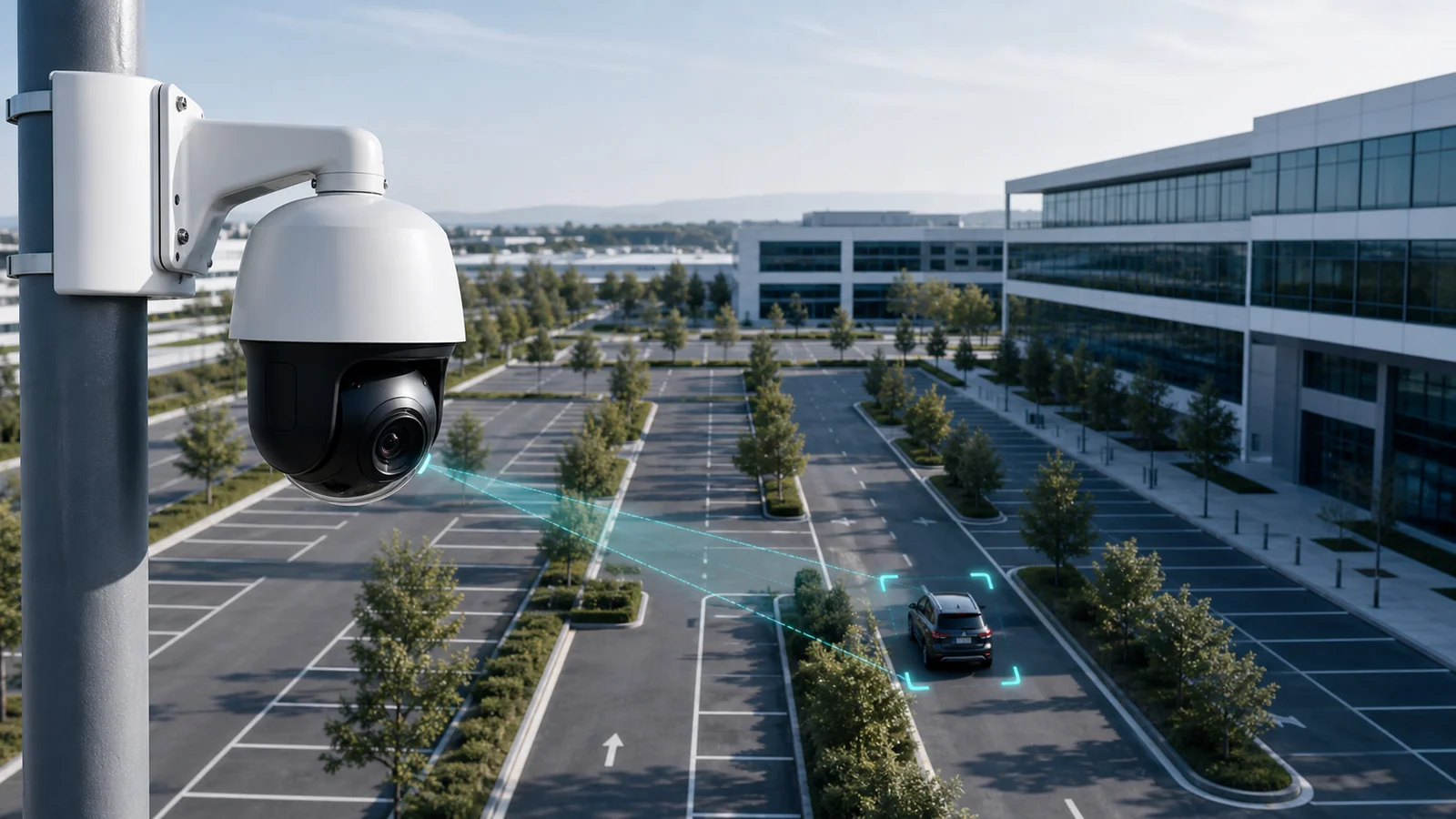
PTZ Camera
Pan, tilt, and zoom — motorised cameras for wide-area surveillance and active tracking
What is a PTZ Camera?
A PTZ camera (Pan-Tilt-Zoom) is an IP camera mounted on a motorised platform that allows the camera to rotate horizontally (pan), tilt vertically, and zoom in or out — all under remote electronic control. Unlike fixed cameras that cover a single static field of view, a PTZ can survey a very large area by moving between positions, and can zoom in on a specific subject for detail when needed.
PTZ cameras are used in scenarios where a single fixed camera cannot cover the required area, where active operator tracking is needed, or where the viewing angle needs to change depending on time of day or event type.
Pan, Tilt, and Zoom Explained
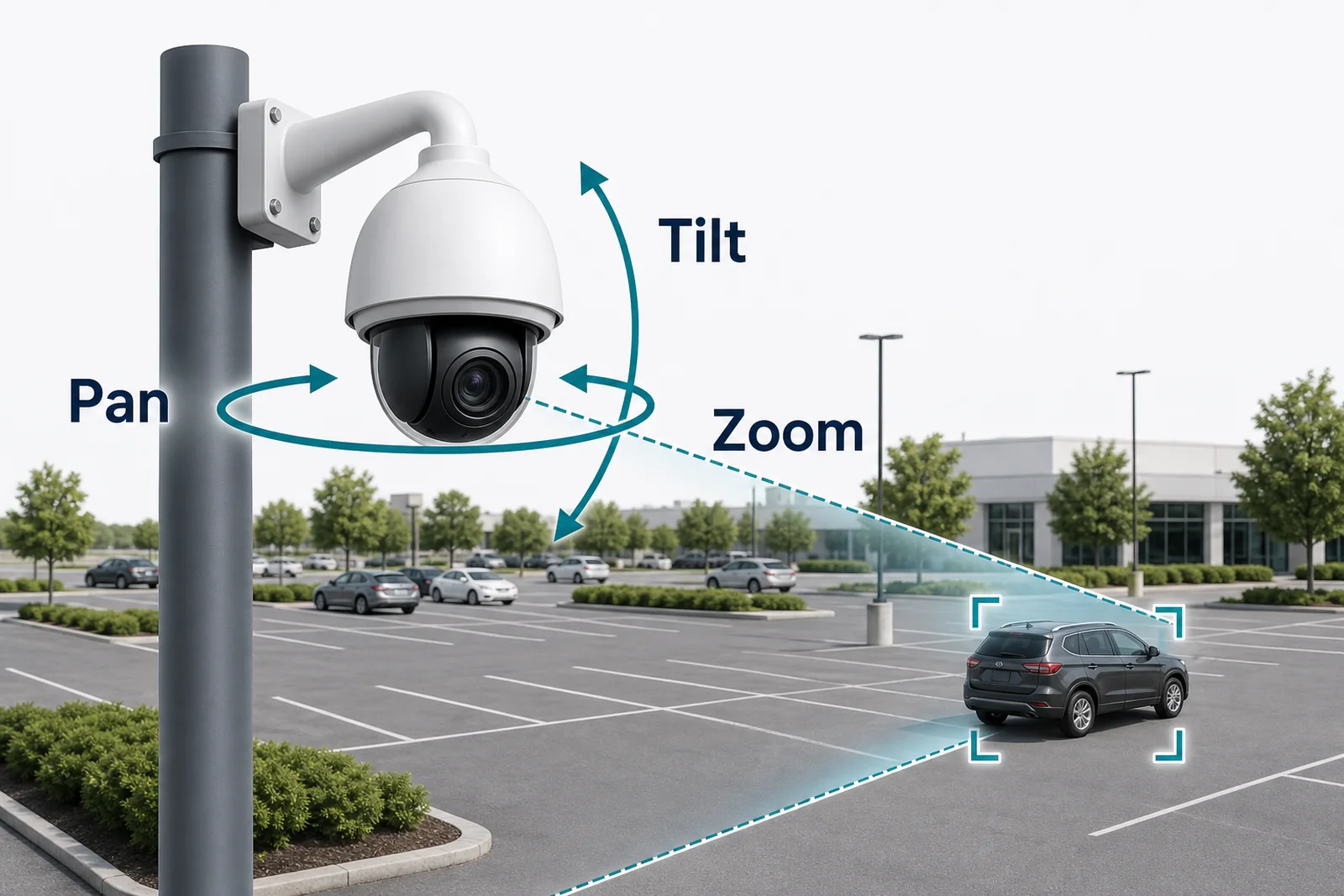
Pan
Horizontal rotation of the camera. Most PTZ cameras offer 360° continuous pan — the camera can rotate a full circle in either direction without stop. Pan speed is typically 0.1°–200° per second, with faster speeds available for auto-tracking fast-moving subjects.
Tilt
Vertical movement of the camera. Typically -90° to +30° from horizontal — pointing straight down to slightly upward. This covers most surveillance scenarios from a ceiling or elevated pole mount.
Zoom
PTZ cameras use optical zoom — a physical lens mechanism that changes focal length, maintaining image quality at all zoom levels. This is fundamentally different from digital zoom (cropping and upscaling), which degrades image quality.
- Optical zoom range: Typically 20× to 40× optical zoom on surveillance PTZ cameras. A 30× optical zoom on a 4 MP sensor can read a licence plate from over 150 m away.
- Combined with high resolution: 4K PTZ cameras with 30× optical zoom provide exceptional detail at long range.
Presets, Patrols, and Auto-Tracking
Presets
A preset is a saved pan/tilt/zoom position that the camera can return to instantly on command. A typical deployment programs 20–100 presets covering key zones — entrance gate, car park zones, perimeter sections, loading bay. Operators can jump between presets with a single click, or the system cycles through them automatically.
Patrol / Tour
A patrol (also called a guard tour or auto-patrol) automatically cycles the camera through a sequence of presets on a timer. Without an operator, the camera continuously sweeps the site on a programmed route. Patrol speed and dwell time at each preset are configurable.
Auto-Tracking
Advanced PTZ cameras include on-camera AI that detects and tracks moving subjects — a person, vehicle, or intruder — automatically panning and tilting to keep the subject centred and zooming in as it moves. Auto-tracking is useful for perimeter breach response and active monitoring without constant operator attention.
Home Position
The camera returns to a defined home position after a period of inactivity or when released by an operator. Typically the widest overview of the scene.
Types of PTZ Camera
- Indoor PTZ dome: Compact, ceiling-mount, discreet housing. Common in large indoor spaces — airports, shopping centres, warehouses. Typically 20× optical zoom, 2–5 MP.
- Outdoor PTZ dome (speed dome): Weatherproof (IP66+) dome housing on a motorised platform. The most common PTZ type for outdoor surveillance. Rated for all-weather operation with built-in wiper on some models.
- Long-range PTZ: Designed for very long distance observation — 60× to 100× optical zoom, often with built-in laser IR illumination for ranges up to 500 m+. Used for critical infrastructure, coastline, and border monitoring.
- Thermal PTZ: Combines a thermal (heat) sensor with a visible-light camera and PTZ movement. Detects intruders by body heat in complete darkness or through smoke. Used for high-security perimeter monitoring.
Key Specifications
- Optical zoom: 20×, 30×, 40× — determines how close you can magnify a distant subject without quality loss.
- Resolution: 2 MP to 4K. Higher resolution + high optical zoom = readable detail at very long range.
- Pan speed: Up to 200°/s for fast auto-tracking. Slower pan speeds (1–10°/s) for smooth manual control.
- IR range: Built-in IR LEDs on most outdoor PTZ — typically 50–200 m. Long-range PTZ may use laser IR for 300–500 m.
- Power: PTZ cameras draw significantly more power than fixed cameras — typically 25–50 W. Requires PoE+ (802.3at) or a separate power supply. Standard PoE (802.3af, 15.4 W) is insufficient for most PTZ cameras.
- IP rating: IP66 minimum for outdoor. IP67 or IP68 for harsh environments.
- ONVIF Profile S + T: Required for Pixuate integration, including PTZ control commands over ONVIF.
PTZ vs Fixed Camera: When to Use Each
| Fixed Camera | PTZ Camera | |
|---|---|---|
| Coverage | Single static field of view | 360° pan, full tilt, variable zoom — one camera covers a large area |
| Cost | Lower | Higher (3–10× fixed camera cost) |
| AI analytics | Continuous — always capturing the full scene | Limited to the current view — misses events in other zones while pointing elsewhere |
| Active monitoring | Passive recording only | Operator can follow and zoom in on subjects |
| Power | PoE (15 W) | PoE+ or dedicated power (25–50 W) |
| Best for | AI analytics that need continuous full-scene data | Wide-area overview, active incident response, verification zoom |
Important for AI analytics: Because a PTZ camera is only looking at one direction at a time, it is not ideal as the primary AI analytics input for continuous detection (counting, violation detection). PTZ cameras are better used as secondary verification cameras — zooming into an alert triggered by a fixed analytics camera to confirm the event and gather evidence.
PTZ Cameras in Pixuate Deployments
In Pixuate deployments, PTZ cameras are typically used in two roles:
- Wide-area overview and operator response: A PTZ provides a live overview of a large zone (car park, construction site, stadium perimeter). When a fixed analytics camera triggers an alert, an operator zooms the PTZ into the alert location to assess and respond.
- Patrol-based monitoring: At unstaffed sites, the PTZ runs an automatic patrol covering key zones, with motion events logged. Fixed analytics cameras handle continuous AI processing while the PTZ provides a moveable eye.
Pixuate integrates with ONVIF-compliant PTZ cameras for PTZ control, preset recall, and stream ingestion. Contact Pixuate to discuss PTZ placement and patrol configuration for your site.
Planning a Wide-Area Surveillance Deployment?
Pixuate can advise on PTZ placement, preset configuration, and how to combine PTZ with fixed analytics cameras for complete site coverage.